Introduction
First-time readers of The Lion, The Witch, and the Wardobe encounter stories and rumors about the great lion, Aslan. But who is he? (If you are not familiar with this text, similar comparisons include the characters of Severus Snape from Harry Potter, Obi-won Kenobi from Star Wars: A New Hope, Aragorn from The Lord of the Rings, and Irene Adler from Sherlock Holmes whose true nature is only revealed overtime across multiple revelations.)
Aslan is described as ‘on the move’ and as a symbol of hope against the witch and her eternal winter. The mention of his name inspires fear, dread, courage, and excitement. The Beavers also stress, however, that Aslan is not a tame lion, but powerful and (at times) terrifying: he cannot be controlled and his plans and intentions are not always clear. Aslan, despite this, is good and will set things right.
How can the reader piece together these tidbits and clues? Only, at last, when the lion is revealed do these seemingly contradictory descriptions finally become clear.
The same sort of situation can be found in the Servant Songs of Isaiah, the climax of the section of Isaiah 40-55. In this section, the announcement that God is returning is proclaimed, but the deficiencies of ‘God’s servant’, Israel, are described as well. How can exiled Israel save itself in order that the world might be saved, and the promises of God reach fulfillment? The Isaian author progressively reveals how the promises of God will be completed in four poems, called the Four Servant Songs. In these, God’s servant is progressively revealed, like the slow revealing of the character of Aslan.
Lesson
The First Servant Song (Isaiah 42.1-9) describes the vocation of the servant along the lines of the commission he has given Israel: light to the nations, the spirit of God resting upon them, suffered but not destroyed, and so forth.
Until the Second Servant Song in chapter 49, we hear a slow, steady build-up of thoughts and ideas which coalesce on God’s coming return. As we approach chapter 49, the repeated cry of ‘listen’ and ‘pay attention’ are heard. In the Second Servant Song, we see a shift in the identity of the servant — can Israel be the identity of the Servant? Read Isaiah 49.1-7.
In the first four verses, an explicit connection between the servant and Israel is made (v3: ‘you are my servant, Israel’). But verses 5 and 6 present a conundrum: the servant would ‘bring Jacob (i.e., Israel) back [from exile]’ and gather Israel to God. How could the nation save itself? The servant must be different…Someone commissioned and empowered by God to first to save Israel and then to bring salvation to the ends of the earth. And, finally, in verse 7 we have a royal vocation (reminding us of the Davidic covenant): the kings and rulers of the world will bow down before the servant.
The Third Servant Song (Isaiah 50.4-9) comes on the heels of the second and describes the servant as suffering, but obedient. In the end, the servant will be vindicated (i.e., shown to have been in the right). But let us turn to the Fourth. Read Isaiah 52.13-53.6 (though the song goes through verse 12). What does this passage tell us about the Servant?
We see themes of suffering and rejection (v14, vv2-3), of exaltation, wisdom, and of being identified with the ‘arm’ of God (v13, v1). But a new element emerges which explains the Servant’s suffering: the Servant will be struck down by God in order to redeem Israel by bearing her sins — like the sacrifices for sin of the goats in Leviticus 16. It is ‘with [the Servant’s] wounds that we (i.e., Israel) are healed’ (v5).
But how is this suffering redemptive for Israel? Like with the goats of Leviticus 16, blood is seen as a detergent — a purifying agent — which brings healing. (This is probably the context of v15 that the Servant will ‘sprinkle many nations’.) God is not punishing the Servant, but destroying every aspect of distorted humanness introduced by the Fall.
Now, we see the God is coming back and that his royal, prophetic, suffering, and redemptive Servant will solve the problem of sin and death from the garden. What will the consequences of these actions be? Read Isaiah 54.1-10 and consider how it relates to the covenants encountered so far.
Isaiah 54 begins with an end to barrenness — those who had no children can now reproduce, and how many children they will have! This should remind us of the Abrahamic covenant and images of the stars in the sky and sand on the beach, so many offspring would Abraham have.
Verses 5-8 discuss redemption — of a people being saved like the Israelites being rescued from Egypt. And, as the people departed Egypt in expectation of a promised land where their God could dwell among them, so verses 9-10 give a new covenant of peace and everlasting love where God dwells will his creation. And, like in the covenant with Noah which was unconditional, so this new covenant will be unconditional — not contigent on Israel’s good behaviour.
There is a building excitement goes through Isaiah 55 which introduces a new theme: New Creation in which all the nations of the earth are invited to participate. Read at least Isaiah 55.1-9, but you can continue to the end of the chapter. Note, particularly, the responsibility of the Israelites listening (or reading) this passage: seek God and his plan which is not equivalent to the plan of human beings. The Israelites (and, in fact, all nations) are to align themselves to God’s plan: to bring about the redemption of the whole world through his Servant, and then to come and live with them under a New Covenant in a New Creation — a restoration of Genesis 1-2.
Reflection
It is for good reason that Isaiah 40-55 is often called the ‘Fifth Gospel’ since it captures the essence of the story of Jesus’ vocation: to be the royal, prophetic, suffering, and redemptive servant — not just on behalf of Israel, but redeeming the whole world from sin and death. This is Aslan appearing at last, of Aragorn revealed as the true king of Gondor, and Obi-won Kenobi as the protector and guide of Luke Skywalker. Before, we did not understand, but, at last, it makes sense: God’s plan for undoing the effects of the Fall.
The Gospel writers and Paul are aware of Isaiah 40-55’s importance and regularly cite or use Isaiah 40-55 in their writings — even orienting their works (as in the case of Mark, especially) to show how Jesus’ coming fulfilled the Isaianic forecast for the Messiah, ushering in a New Covenant and a New Creation for all of mankind.
In light of this, the Israelites were called to seek God and to follow his plan. We too are given the vocation of seeking God and following his plans and designs for our own lives.
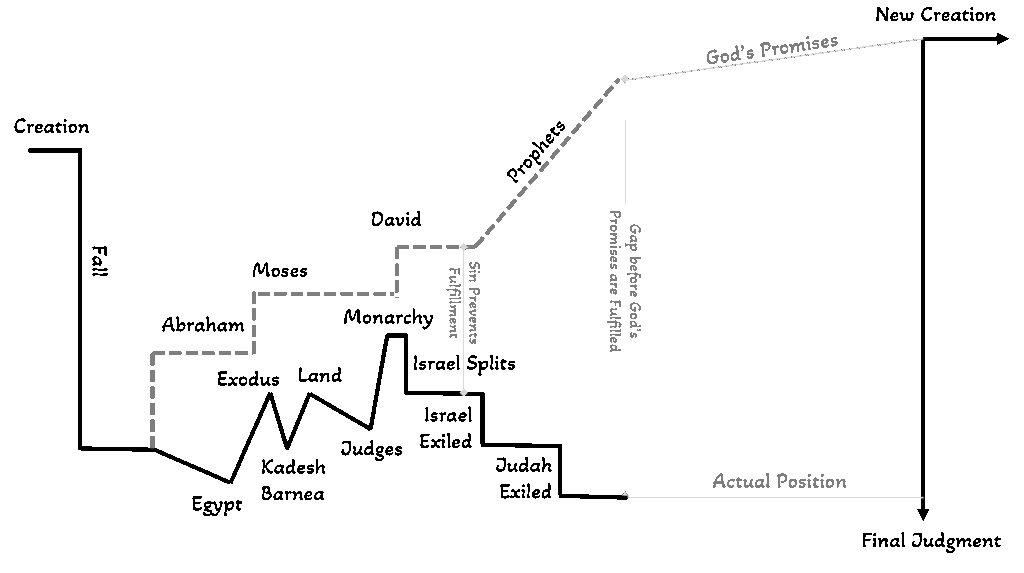
We can update our diagram too. Even though the Israelites remain as low as in Egypt prior to the Exodus (in some sense, they’re back as slaves in Egypt), the promises given by God are nearly complete and point toward a situation much grander than their current experience.
This will be our final lesson in the Old Testament prophets, and we return to the historical books to cover the remaining years prior to the birth of Jesus.