Introduction
Once again, we draw our lesson from Leviticus, but this time chapter 26. Leviticus often reads as an unordered collection of practices and can be difficult to make sense of the ordering. Our current passage, however, clearly builds on Leviticus 25 which emphasizes Jubilee, the fifty-year practice of resetting the social landscape of the land. Here, on Mt. Sinai, God is already laying out provisions for how the Israelites ought to behave in their land. This tent-dwelling people, scattered between the mountains with their livestock, must learn what to do when they have become a settled people — or, rather, God’s settled people. These practices include care for the poor and treating travelers and visitors well, but also giving the land and its people rest. Every seventh day (i.e., the Sabbath), there was not to be any work — it was a day of rest, looking back ultimately to God’s resting after completing Creation. In the same way, every seventh year was to be a Sabbath year, letting the land and its people rest. Then, after seven sevens of year (i.e., 49 years), everything was to be begun again fresh. In the fiftieth year, the Jubilee year, people were to return to their ancestral lands, those who had been compelled to sell themselves as slaves were to go free, and those who had acquired vast swaths of land were to give it back to their original owners. The land and its inhabitants would be created new. If the Israelite followed these dictates, they would live long and prosperously in the land.
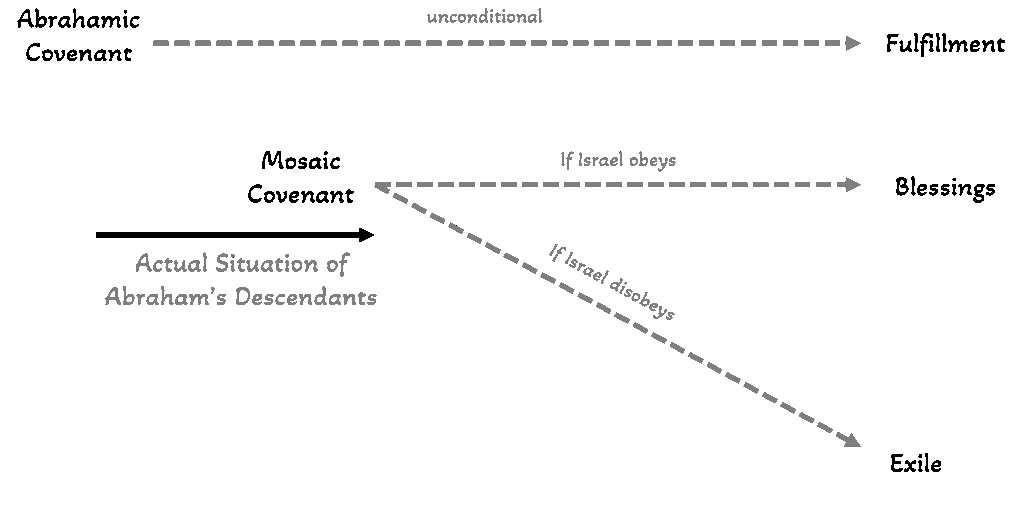
With this as our context, Leviticus 26 (presented in parallel in Deuteronomy 29-31) again emphasizes that in order to maintain the land, proper practices must be maintained by the Israelites. These are the conditions of their continued thriving when they arrive in the promised land. And, in so doing, God makes an agreement with the Israelites, a covenant with the entire people. This, however, is not the unconditional covenants for land and children given to Abraham, or that signified by the rainbow to Noah, but one which required from the Israelites: a conditional covenant. Let’s explore this in more detail.
Lesson
Pay attention to the conditions of the agreement as you read Leviticus 26.3-13. The condition is given at the beginning: if you follow God’s laws — i.e., if you follow the Ten Commandments. Importantly, this does not require perfection, as Exodus 32-34 (the Golden Calf) and Leviticus 16 (the sacrificed goat and scapegoat) suggest. Instead, the people are to dedicate themselves to following these statutes as best as possible, offering sacrifice for failures, and generally following God’s plan. What will be the benefit? What does God offer in exchange? The list is quite long but can be summarized as a fruitful land, peace on all sides, many descendants, and God dwelling among them. They would be God’s people, and he would be their God — the same God who saved them from slavery in Egypt.
Those are the conditions of obedience, but the next section provides a set of consequences (or curses) for disobedience. Read Leviticus 26.14-20. The litany of curses continues through verse 39, but we have a sufficient summary for our discussion. First, note that the idea is ‘spurning’ and rejecting the covenant not being unable to follow it continually due to human weakness. Second, most of the curses correspond due to reversals of the blessings from 3-13, with the addition of sickness and disease. Instead of rest, you shall be ruled by enemies and suffer. In place of a productive land, the earth will refuse to yield its fruits. Through these blessings and curses, we can hear the echoes of blessings in Genesis 1-2 (be fruitful and multiply, just dominion) and the curses of Genesis 3 (painful labor).
We might ask the question, however, that if the Israelites choose the way of curses and the path to destruction, is there any hope? How long will the curses last? To answer these questions, we can read the conclusion of this section in Leviticus 26.40-42.
Within the covenant, God makes allowance for human weakness, almost hinting that these curses will lead to repentance. The Israelites must ‘confess their iniquity’ (i.e., admit their sins, confession) and ‘make amends’ (i.e., fix the consequences of their actions, penance). Then, God will ‘remember’ his covenant. This ‘remember’ is not because of his forgetfulness, but indicates that God is ready to take action. This is the same remembering that preceded the sending of Moses to Egypt to begin the recovery process. The remembering hints that even when the Israelites have failed, the covenant is not completely finished: their is always a hope that follows confession and penance.
This section establishes the framework of Blessings and Curses (or, Warnings) which will guide the remainder of the Old Testament: will the Israelites be obedient and inherit the blessings of God, or will they reject their God and face Exile from the land (and from God)? The Israelites head out from the Mt. Sinai region different than how they arrived. They now have a formal covenant which guarantees the presence and providence of God, in exchange for living their lives according to how God designed humans to behave. Heading northward, they arrive on the borders of the land at Kadesh Barnea. They are ready to enter and claim their promised inheritance: fruitful land and peace on all sides.
God directs them to select spies to travel the land in preparation for their entry: from each tribe, a spy is selected. The twelve spies traverse the land and return. Their message is simple: the land is productive and beautiful, but the people of the land appear strong, fortified, and mighty. Ten of the spies speak fearfully and claim that the people of the land are too strong for them. Two, Joshua and Caleb, encourage the conquest of the land for God is with them. Let’s read the people’s response in Numbers 14.1-4.
‘“Would it not be better for us to go back to Egypt?”’ This was not the first time this objection was raised; at each struggle they faced, soon the proclamation that life was better in slavery in Egypt, revealing a deep mistrust of God and God’s plan. Sure, we saw the fireworks in Egypt: plagues and a separating of the seas, victory over enemies. But now it would have been better if none of that had happened. There is a certain ease in slavery — not having to make decisions, not requiring the taking of risk. The state was less than ideal, but at least it was predictable. When you follow God, the predictability passes away. This is what is meant by living by ‘faith’ — living in a complete trust of God, despite fears, instability, and an inability to see around the corner to what might happen next.
Moses again intercedes for the people, invoking God’s mercy that God would not wipe out them out, and continue to be their people in spite of disobedience. The ten spies who led the ideological rebellion die by disease (cf. the curses of Leviticus 26), and the rest of the adults are condemned to not enter the land (apart from the two spies who encouraged following God’s plan). The Israelites saw the error of their ways, changed their mind about trusting God, and many chose to invade the land, but without Moses and the Ark of the Covenant (i.e., without God), they were crushed. Forty years they must spend as shepherds in the wilderness, on the borders of the land that they had nearly entered. They must eke out a living in the desert, in view of the fruitful land they might have occupied. Apart from Joshua and Caleb, no one led out of Egypt, having witnessed the glorious acts of God, would see the land.
Reflection
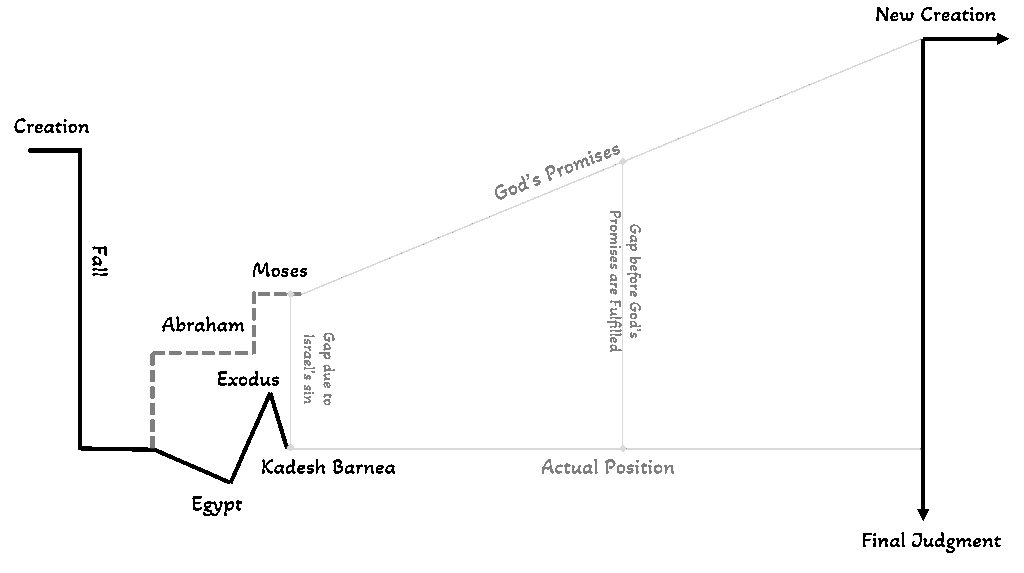
The Israelite journey from the crossing of the Sea until Kadesh Barnea, on the edge of the land, is instructive. It reveals the negotiation of God and people. How dearly God desired (and desires) to have a relationship with people, to have them freely choose to live the ‘very good’ lives God intended them, and to effect a restoration of the ‘walking’ in the Garden. The Land could become the Garden of Eden if they can behave appropriately. But the wickedness brought about by sin is difficult to avoid. The convenience of slavery to sin, of living selfish lives, is too strong. The promises, hopes, and expectations are unfulfilled, as seen in the diagram below.
We can also chart out the main covenants we have encountered so far: Abraham and Moses.
A common reaction to observing the failings of the Israelites is to laugh and condemn their fickleness. We must not, however, be too quick to judge, as we ourselves rush to fulfill our selfishness: to blame others for our failings, react in self-centered anger (and wrongly claim it as just), proclaim our own holiness, and seek our own gains and interests over others. We so often place ourselves as the Golden Calf and expect the world to revolve around us, failing to grow up.
It is through Jesus that this pervasive sin has been dealt with, and that God’s spirit might dwell in us to effect a deeper change in our behavior and outlook. It is the power to learn to follow God’s law, to begin the process of collaboratively recovering the ‘very good’-ness of Eden (cf. the Promised Land). This trust (i.e., faith) requires a risky obedience to God, not the safety and security offered by the mirage of slavery in Egypt. It is this proclamation, coupled with the cry of Jubilee in Leviticus 25, that we find in Jesus’ words about his own ministry, recorded in Luke 4:
The Spirit of the Lord is upon me, because he has anointed me to proclaim good news to the poor. He has sent me to proclaim liberty to the captives and recovering of sight to the blind, to set at liberty those who are oppressed, to proclaim the year of the Lord’s favor.