
Introduction
The Israelites were so close to entering the land. Close enough to dispatch spies, but also close enough to cause fear: this was really happening — to what extent could they trust God? How much more simple was living life as slaves in Egypt: well-defined responsibilities and predictability. No need for the moral challenges of venturing off to face dragons. And while many would later repent of their wavering, they had condemned God and his actions in their rescue. Even worse, they had disobeyed the Mosaic covenant, and so they forfeited the divine favor and blessings attached to the covenant promises. The condemnation was laid: none of those who had seen the miracles of the Exodus would enter the promised land, except the faithful spies, Joshua and Caleb.
Now, forty years were passed, and the generation with them. Even Moses was laid to rest and replaced by Joshua. Assembling on the eastern bank of the Jordan, the waters parted before them as the priests carried the ark of the covenant, the symbol of God’s presence, across on dry land. This next generation could see a distant mirror of the Exodus and ready themselves for the fulfillment of God’s promises. The book of Joshua recounts the Israelite invasion and conquest of much of the promised land. This might have been the end of the story, except that the Mosaic covenant required continual obedience and purification of sins. Even under Joshua, as under Moses, the Israelites failed, allowing many tribes and peoples to remain in the land, serving as negative pressures in the future. And thus, the book of Joshua is followed by the book of Judges which picks up the story in its dismal and rather compromised situation. Let us begin our study here and see what the state of the land is here at the twilight of Joshua’s life.
Lesson
The state of affairs at the end of Joshua’s life is usefully presented in Judges 2, and this serves as the foundation for the rest of the book. Read Judges 2.1-10 and consider what went wrong, particularly with reference to the Mosaic covenant.
The Mosaic covenant required the obedience of the Israelites: adherence to the law and the regular practices of purification. In return, God promised to dwell among them and to give them a productive land, secure on its borders. The Israelites had not done this (and the records of Israel’s failure occur throughout the book of Joshua). And now, the people realized their failure (a realization comparable to that at Kadesh Barnea), but it was too late. The die was cast; their leader was dead and buried; and a new generation arose not personally familiar with the great works of God. Even worse, they did not know God. This itself is another Israelite shortcoming, and the details of which are left to the reader’s imagination. Did they not celebrate the Passover? Keep the Sabbath? Practice rituals of purification including the sacrificed and scape-goats? Regardless, the Israelites, now scattered across the land, had largely abandoned God.
The rest of the second chapter of Judges enumerates the consequences of this disobedience, aligning with agreements made in the Mosaic covenant. Read Judges 2.11-23.
The first part of this passage describes the problem as the Israelites neglect their role as God’s chosen people, becoming identical to the peoples surrounding them: serving their gods and neglecting their duties according to the Mosaic covenant. For this reason, God withdrew his blessings and fulfilled his warnings and curses, causing them to be defeated and enslaved. In this distress, however, God was moved to pity and sought to save them like when God had raised Moses to set the Israelites free from their bondage in Egypt. The judge would lead the rescue operation, but once the immediate crisis had passed, the people would refuse to listen to the voice of the judge, rejecting God’s leadership. This, in brief, is the story of the book of Judges: cycles of rejection, exile, salvation, and rejection once more.
The final three verses carry a greater doom: the Israelites’ repeated covenant failure led God to vow not to give them the entirety of the promised land — at least for now. These other nations would remain to repeatedly test the Israelites, assessing their loyalty to God and his commandments. And so, throughout the book of Judges, they do serve as just such a test. The endless cycle of the Israelites chasing after foreign gods, being surrendered by God to the depradations of some enemy, the Israelite call for help, God’s raising a judge (e.g., Samson, Deborah, Gideon, etc.), and the consequent freedom of the Israelites. Always, however, they fall away again. The book becomes depressing in its repetition.
As the book nears its close, however, there is a repeated invocation that obliquely promises a better, more stable future. The book closes with it: ‘In those days there was no king in Israel. Everyone did what was right in his own eyes.’ The description of everyone doing what they thought was right brings to mind the context of the Flood in Genesis 6. Perhaps a king will solve the problem. Perhaps then the promises made to Abraham, Isaac, and Jacob might finally be fulfilled.
Reflection
The book of Judges looks forward to the transition from judge to kingly rule, and the next book (1 Samuel) narrates the selection of the first king of Israel. Before we press on, however, let us look back and consider the promises God has made and the extent to which they have been fulfilled.
First, Israel has only acquired some of the land because of their wickedness and disobedience to God. Second, their work in the land is not blessed, with little in the way of peace and prosperity, and many living in the infertile hill country. Third, they are not a great nation, even making war amongst themselves (e.g., Judges 19-20). Finally, God appears to be the initiator of any relationship between God and Man, but it is a relationship more of enmity than of harmony and friendship. Significantly, these deficits are the consequence of the Israelites’ disobedience: sinning and angering God. They had collectively taken the path of curses rather than blessings (cf. Leviticus 16, Deuteronomy 28).
The promises to Abraham — land, descendants, and blessing to the nations — are still not fully realized, and Judges shows just how far short Israel falls, as is suggested in this update to our diagram.
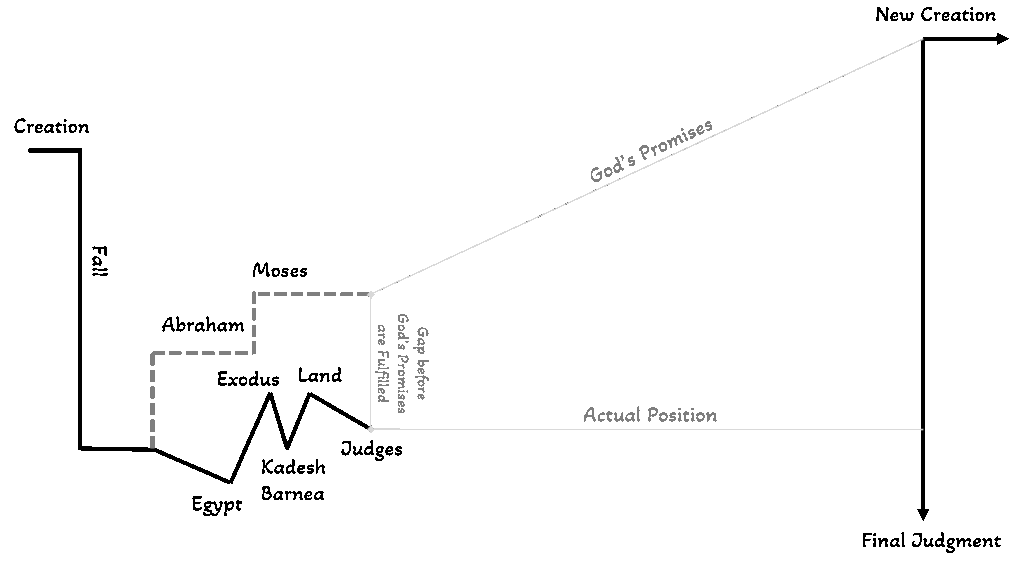
How could the situation be improved? We might recall from two lessons ago that sacrifice helps to remove the stain of sin, at least to some extent. The book of Judges also foreshadows how a strong leader might help (cf. 17.6, 18.1, 19.1, 21.25), perhaps looking back to the leadership of Moses who helped mediate between God and Man. We will turn in the next lesson to just such a strong leader as the Israelites welcome their first king.