Introduction
We have begun to see the beginning of God’s fulfillment of the promises he made to Abraham. The Israelites remain at the foot of Mt. Sinai receiving the Law (and, as we’ll discuss next week, taking part in the Mosaic Covenant) having been rescued from Egypt. As part of this, God has called the Israelites his people and desires to dwell among them — he is offering them a privileged relationship with himself. However, the problem of human wickedness and sin has not been resolved as we saw last week in the Golden Calf, where the same Israelites who watched the ‘fireworks’ of the Exodus abandoned their rescuer. In this lesson, we’ll explore the various measures in which the priests help to expiate the sin of the community each year, thereby purifying themselves for the presence of God.
In doing so, we’ll bid adieu to the book of Exodus, and turn to the next book, Leviticus — a book often lambasted for its legal code, but these must be seen in light of Mt. Sinai: the recipients of freedom from slavery who have chosen to enter into a special relationship with God. The rest of Exodus focuses on the working out of the Ten Commandments, and climaxes with the construction of the Tabernacle — a tent where God would come to dwell with the Israelites (and the forerunner of the Temple, presented in Part 15). This is the climax of Exodus: that the people and God might dwell together as in the unspoilt Garden.
The third book of Torah, Leviticus, is chiefly concerned with the behavior of the Israelites and how they can maintain holiness (i.e., how they should sacrifice, what offerings should be made to God, how to atone for sins, and various festivals and celebrations). The name derives from ‘Levite’, though in the context of the book probably means something like ‘priestly’ as the Levites themselves are rarely mentioned.
Today, we’ll be looking at one of these celebrations — the Day of Atonement — and consider its impacts both for the Israelites at the time, and consider its implications for the post-Jesus, New Testament world. In fact, the author of Hebrews draws heavily on the priestly rituals presented here in Leviticus, seeing Jesus as their fulfillment (i.e., our Perfect High Priest and Perfect Sacrifice), so we’ll peak ahead and read into Hebrews 9 (we’ll revisit this section in Part 29).
Lesson
To begin with, consider what sort of obstacles prevent or have ruined friendships or other relationships. Would you be able to maintain or restore a friendship with family, friends, colleagues, or others if these hindrances continued? Why can’t you just ‘get over’ them? Well, as we’ve discussed in prior lessons, sin and wickedness is an obstacle which interferes with our ability to have a relationship with God. Unfortunately, we, like the ancient Israelites encamped around the holy mountain, continually fail — we regularly set up our own ‘golden calves’ (often, ourselves) to follow in place of God.
Leviticus 11-15 highlights how ‘unclean’ the Israelites and the things around them are. The language of ‘unclean’ is used throughout, but we might translate this better as ‘unacceptable to God’ (including ritual impurity which is both physical and spiritual, relating to holiness and community life). There are practices and behaviors which even more completely corrupt humanity, losing their image-bearing nature as, for example, J.R.R. Tolkien’s Smeagol became corrupted into Gollum. The sacrificial system is established to clean and purify, requiring the giving up of something valuable: a sacrifice. The greatest example of this system and what it accomplishes can be found in Leviticus 16.
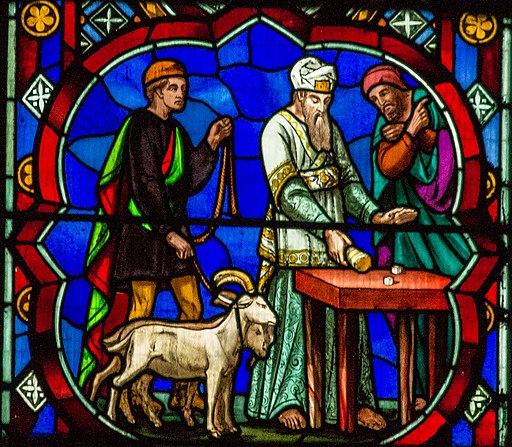
Read Leviticus 16.6-22 (or begin at v.1 for more context) and focus on the two goats and their respective roles.
What happens to the two goats? One is killed as an offering for sin, while the other is sent out into the wilderness, away from the Israelite camp. Herein we have two different methods for dealing with the uncleanness in the community, for all the uncleanness must be dealt with — even unintentional or forgotten acts. Somehow, the blood of an animal cleanses this sin, perhaps in a sense suggesting that our own lives are forfeit due to this uncleanness. Our thoughts may return to Part 3 of this series, where even though all may be subject to destruction, God’s mercy (cf. the rainbow) and desire to have relationship with mankind prevents this.
What about the other goat? Sin here is handled by expulsion from what is intended to be holy (i.e., set apart, sacred). We can recall Part 2 of this series, where Adam and Eve, having exalted themselves in place of God are condemned to depart from the Garden. Sending the goat into the wilderness also offers a reassurance that the sins in the community have been expelled.
Looking forward to the New Testament, we see analogs for the handling of sin in Jesus. Jesus, who acted as the ’scapegoat’ (i.e., the goat sent into the wilderness), bore our uncleanness and, as the sin offering, suffered and died as a sacrifice to atone for sins (i.e., cleanse our uncleanness), thereby making us acceptable to God. It is by Jesus’ sacrifice that we have a restored relationship with God, as was the role of the goats on the Day of Atonement.
Before turning to the New Testament interpretation of these events, let us linger on two more verse in Leviticus introducing the ‘Day of Atonement’. Read Leviticus 16.29-31.
How often is the Day of Atonement to be repeated? Every year these events must take place because of the continued sin of the people, requiring continued ‘cleansing’ and returning of the Israelites to a state of holiness that God might dwell among them. The Day of Atonement (i.e., Yom Kippur) is still practiced today in Jewish commiunities. It is the holiest day in the Jewish year and falls toward the end of September/early October.
Now, let us turn to the New Testament book of Hebrews where the author is discussing the role of Jesus. We’ll discuss the context more fully in Part 29, so we can jump in and read Hebrews 9.1-14.
The first section (9.1-10) reflects on the annual Day of Atonement, how the imperfect high priest must atone for himself and for the entire congregation. It, however, was unable to solve the problem. Jesus, argues Hebrews 9.11-14 (and following), is the Perfect High Priest who has entered the Tabernacle and accomplished the ultimate sacrifice, solving the underlying problem so that this ritual need not be repeated.
Reflection
We have peeked at the ending, the fulfillment toward which these rituals are pointing, but let us return to Aaron and his successors. The Day of Atonement will deal with the uncleanness within the Israelite camp and restore the camp’s holiness. God could come and dwell with his people, but the underlying fallenness had not been resolved. The rituals must be regularly repeated and atonement made in order to enjoy the presence of God.
Sin separates humans from God, placing an obstacle in the relationship of Man and God. The temptation to sin is part of human nature, and uncleanness regularly enters into the hearts of people. God is seeking to remove this impurity to restore humans to himself, as we saw hinted at in Hebrews 9. Ultimately, this reconciliation with God can be glimpsed again in Revelation 21-22, but we are not there yet.
Next, we will turn to God’s making a formal agreement, a ‘new covenant’ with his chosen people which will focus on their relationship and its obligations. Unlike with the one given to Abraham, this one, the Mosaic Covenant, will have certain conditions which the Israelites must commit to and fulfill.