Introduction
In the last lesson, God made another promise — an unconditional covenant with David, king of Israel. This promised an unending dynasty and kingdom, with God as father to the king. Under David, the conquest of the promised land was now complete, and a Temple would be built by David’s son by Bathsheba, Solomon. It seemed that the fulfillment of the promises was near.
Lesson
Let’s begin by reading 1 Kings 4.20-30 (focusing on 20-21, 29-32) which describes the conditions under the reign of Solomon, considering in particular the degree to which the covenants have been fulfilled.
The passage describes a numerous people — they have been fruitful and multiplied, filling the land — dwelling in a large kingdom and at rest, with peace on the borders of Solomon’s kingdom. Not only is the land at peace, but they are led by a wise ruler, to whom pilgrimages are made to hear his teachings and instructions from as far away as modern Ethiopia. His name became a byword for ‘wisdom’, composing 3000 proverbs (v. 32) and having the book of Proverbs largely attributed to him.
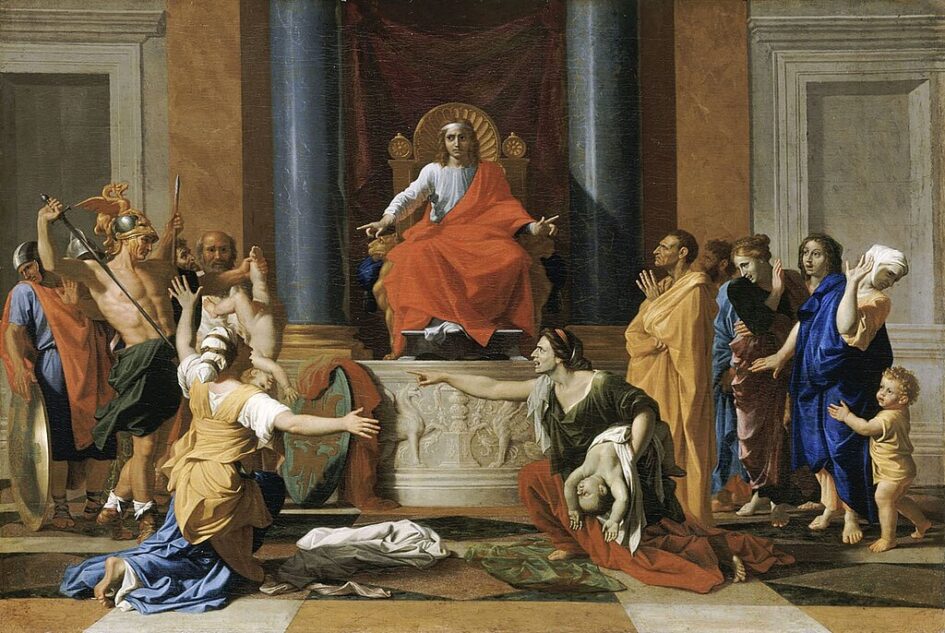
The next five chapters (1 Kings 5-10) build on this exalted state, as Solomon orders the construction of the Temple, the static replacement of the Tabernacle as a permanent location for God to dwell with Man. The ark of the covenant was moved into this grand edifice, and God renewed his covenant with Solomon and the people (6.12-13, 8.12-21, 9.1-9), promising peace and prosperity should the king continue in the ways of God. This was surely the fulfillment of the Davidic covenant, the completion of the promises of God…But read 1 Kings 11.1-13 and consider how God’s blessings and promises are fulfilled in Solomon (or not). Does this Solomon sound like the wise, godly ruler described in Deuteronomy 17?
This does not seem to be the same king we heard about in 1 Kings 4, but echoes the concerns God raised in 1 Samuel 8 about a king that would place himself above his people and above the laws of God. Deuteronomy records laws not to marry outsiders (7.1-5) nor amass horses or wives (17.14-20), but to destroy the high places (12.1-6) lest the Israelites be tempted to worship other gods. As a consequence of Solomon’s infidelity to God, God told him that this kingdom would be torn apart — we heard Samuel give similar words to Saul after his own failure to place obedience to God above his own desires. However, importantly, God would not renege on his commitment to David for an eternal house, kingdom, and that his offspring shall be God’s son.
Thus, despite all of Solomon’s great wisdom, he allowed disobedience to creep in (like Saul) which turned his heart from God. While 1 Kings 11 announces the change suddenly, we should probably imagine a slow progression of heightened self-importance and self-interest. As a result, Solomon was the last ruler of all twelve tribes — in retrospect, called the United Kingdom. The northern ten tribes (henceforth called Israel or Ephraim) would break away under Jeroboam. The southern tribe (well, two tribes, though Judah dominates) is Judah and ruled by Rehoboam and centered around its capital, Jerusalem. While initially obedient to God, Israel’s king Jeroboam is concerned with the worship of the ten northern tribes being directed at Jerusalem in the south — would not this result in the religious pre-eminence and authority of the southern kingdom/Judah? Therefore, Jeroboam set up two calves of gold to receive the worship of his people (see 1 Kings 12.25ff), an act implicitly recreating Aaron’s (and the Israelites’) sin at Sinai. What do you think the result was of this turning away? Kings and Chronicles judge all of the northern kings as ‘bad’ since all of them followed Jeroboam’s example in turning away from God.
We will skip forward, ignoring two hundred years of ‘bad’ kings in Israel (i.e., the Northern Kingdom), and focus on the final king: Jeroboam’s last successor, Hoshea. Read 2 Kings 17.1-14 to find out what happens.
The Northern Kingdom, Israel, is not only defeated by the Assyrians, but deported to a distant land. The political cause of this action was Hoshea’s betrayal of Assyria, seeking an ally in Egypt, but 2 Kings 17 hints at a deeper, theological origin to the political events: Israel’s sin. This was a sin dating back to Solomon and Jeroboam, who had turned away from obedience to God. Now, all of the northern tribes were no more: deported with a loss of their ethnic and religious identity as God’s chosen people. Foreigners were brought into what had once been the northern kingdom, inter-marrying with those who remained behind, and bringing new traditions which would eventually become the Samaritans of Jesus’ day.
Reflection
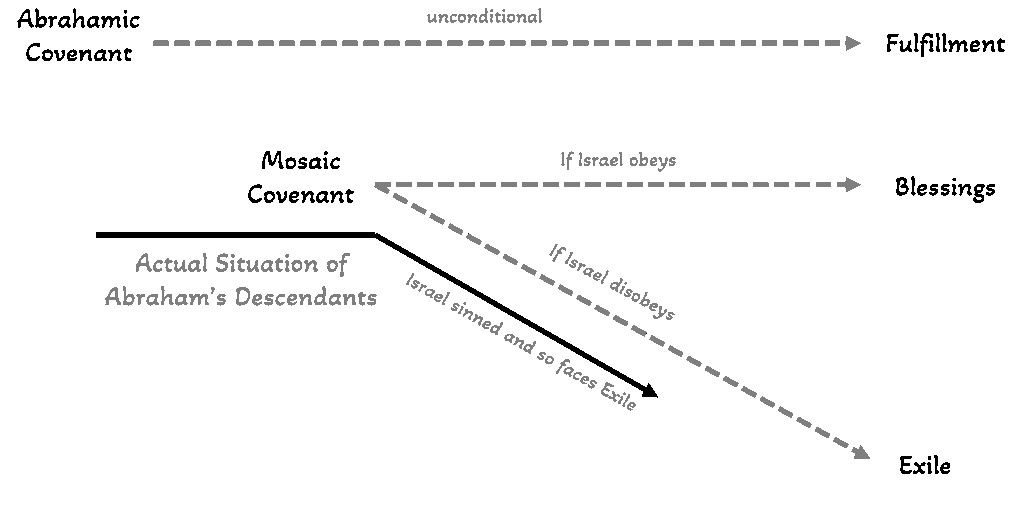
Have God’s promises failed with the exile and loss of identity of the northern tribes? We will approach this question from two different angles. First, the Northern Kingdom received the promised consequences given in the warnings and curses related to the Mosaic covenant: they had turned from God and therefore forfeited the promises. It did, however, take over two hundred years for the consequences to take effect, showing God’s patience and mercy as he waited for their iniquity to be complete. God repeatedly sent prophets calling out to the people and their wicked kings to turn back to God. God repeatedly chose to work through humanity, in spite of their moral failings, to set things right. The people and their rulers, by and large, refused to repent and change their ways. The consequences of their disobedience was eventually realized and these ten tribes, the descendants of those that had crossed the parted seas and stood at the foot of a thundering Mt. Sinai, were gone.
This did not mean the end of God’s promises to Abraham and David. These covenants had unconditional elements which God had not forgotten. While the ten northern tribes had been exiled, God selected a remnant to receive his promises. Judah, the southern kingdom, will now be the focus of the remainder of this study. We will focus on the prophets to the southern kingdom, beginning with Isaiah, and see not only their cries for repentance, but also their statements about how God will act to rescue his people. Thus, even amid judgement, the thread of divine fidelity remained unbroken, setting the stage for Judah’s story and the prophetic hope that follows.
Here we see the current state of the Israelites relative to the promised hope:
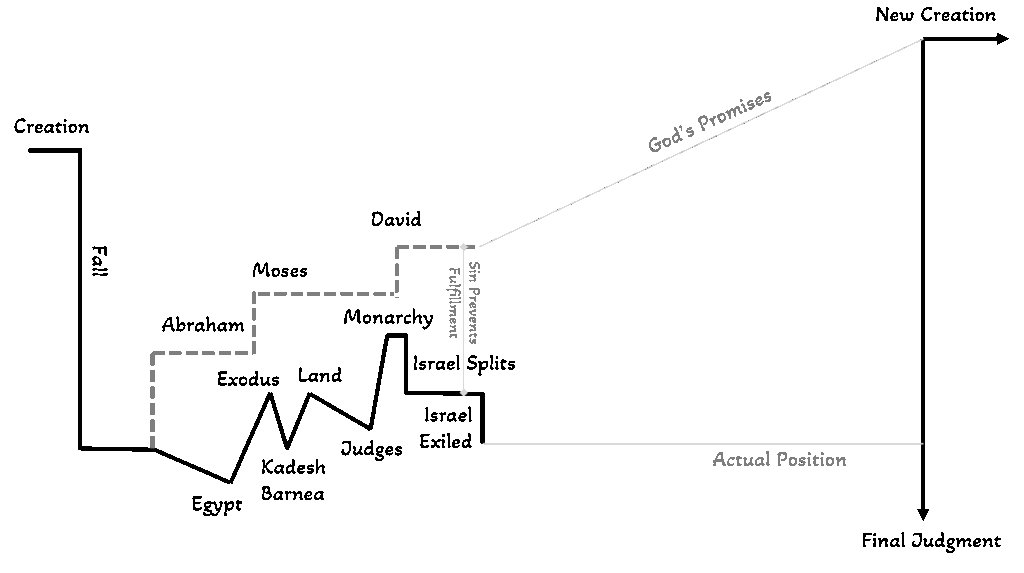
And we can add a component of the diagram to show Israel’s decision to sin, and the resulting Exile, following the Mosaic Covenant.