Introduction
The Israelites had conquered the promised land, but it was not how their ancestors would have envisioned it. ‘In those days there was no king in Israel. Everyone did what was right in his own eyes.’ So end the book of Judges, leaving this description of everyone doing what they thought was right, recalling the immediate context of the Flood in Genesis 6 when wickedness extended to every corner of the world. Perhaps a king will solve the problem. Perhaps then the promises that God made to Abraham, Isaac, and Jacob — the Abrahamic covenant — might finally be fulfilled.
We must leave behind Judges and pick up the narrative in 1 Samuel, when Israel was under the leadership of the judge Samuel, for whom this and the subsequent books are named. Samuel was the last judge, and witnessed the transition of Israel to a monarchy, anointing both of the first two kings: Saul in 1 Samuel, and David who becomes the ruler in 2 Samuel. The subsequent Old Testament books of 1 & 2 Kings and 1 & 2 Chronicles provide largely parallel accounts of the kings of Israel and Judah.
The story of the kings is of particular importance in the Story of the Bible as it will manage to solve many of the problems the Israelites experienced under the Judges, will result in a complete conquest of the Land, and even after the division of Israel into two vying kingdoms, Messianic echoes will ring into the New Testament.
Lesson
We arrive in 1 Samuel where the Israelites are largely under the leadership of the judge Samuel. He is growing old with his sons, Joel and Abijah, beginning to take over his position. The Israelites, however, are somewhat uncomfortable with this future and would rather not have the sons of Samuel as their judges. Perhaps a king would solve their problem? Read 1 Samuel 8.1-9 and consider what is deemed wrong about the people’s demand for a king.
Can you imagine yourself among the people at Ramah? Samuel’s sons are corrupt, and the anger in the air is palpable. The crowd is restless, filled with resentment and fear. ‘Give us a king,’ they shout, with some justification. Who would want to be ruled by the corrupt Joel and Abijah? Samuel stands calmly before the people. He has a lot experience with angry crowds, but also in trusting God. He well knows the rumors of corruption, but hoped it wasn’t true. He retreats in privacy and falls on his knees before God, waiting to hear the divine voice: ‘The people have rejected me.’ Why? Did God want them to be ruled by Samuel’s corrupt offspring?
No, the problem was not the desire to be ruled by someone other than Joel and Abijah. Had they instead demanded a righteous ruler to come after Samuel rather than his sons, then they would not be rejecting God. Instead, they desired ‘a king to judge us like all the nations.’ They were instead rejecting their uniqueness as God’s people, departing from their God-given role as a ‘holy nation’ and ‘kingdom of priests’. Instead, they wanted to be like everyone else. But God relents, and chooses to integrate kingship into his plan.
While 1 Samuel 8 presents a quite negative view of kings (see, esp. 1 Samuel 8.10-18), the books in the Torah are generally positive (or, at least, not explicitly negative). For example, read Deuteronomy 17.14-20 and consider what are good attributes a king ought to possess. This passage mentions that king must be an Israelite, that he must not seek personal gain or power, and that he must be subservient to God and his commandments. Would you think such a person makes a good ruler? One with moral restraint and submission to a higher law? This is the vision of kingship directed by God, which contrasts sharply with the predictions God makes in 1 Samuel 8.10-18 in describing, not the king of Deuteronomy 17, but a king akin to the other nations: one pursuing his own self interest and aggrandizement. With such a king like other nations, says God, ‘And in that day you will cry out because of your king, whom you have chosen for yourselves, but the LORD will not answer you in that day.’
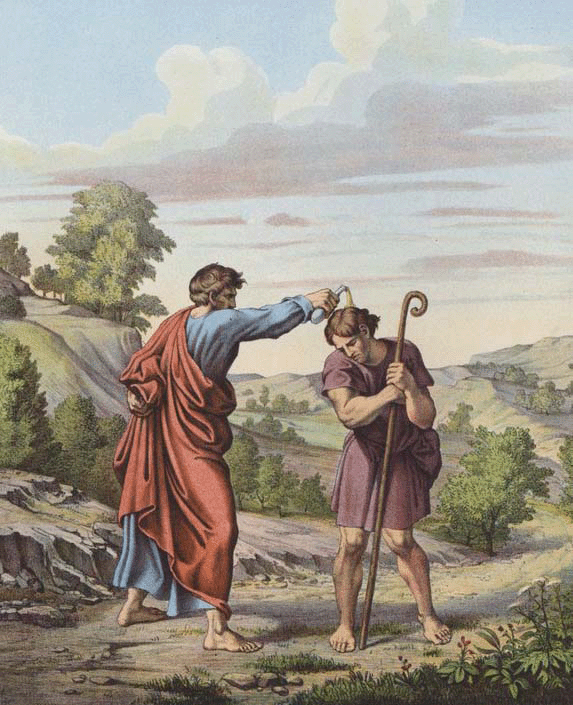
Returning to 1 Samuel, we can follow the selection of Israel’s first king, Saul. Samuel anointed the latter king while Saul was looking for his father’s donkeys and filled with the spirit of God, but it took some time before he rose to his regal position — probably not until he began to have military victories against Israel’s enemies, slowly resuming the conquests of Joshua centuries before. It was after a military victory over the Ammonites (1 Samuel 11) that Saul is finally crowned king.
Saul led many campaigns against the Moabites, Ammonites, Philistines, and Amalekites, proving the cry of the book of Judges for central leadership correct. However, in one campaign against the Amalekites, God told Saul to devote everything to destruction — a judgement on the people of Amalek for their wickedness and crimes, and one from which Saul and his army could claim no booty. While there are some interesting moral considerations, we’ll need to sidestep them for now to focus on Saul’s actions: read 1 Samuel 15.17-24. How does Saul sin and what are the consequences?
In his campaign against the Amalekites, Saul chooses not to devote everything to destruction, taking ‘booty’ against God’s commands. Saul offers a rather pathetic excuse, first blaming his army and then saying that the captured animals were to be given as a sacrifice to God. As a result of these actions, God rejects Saul and his dynasty, declaring that what he truly desires is not sacrifice, but obedience. Saul’s sin was disobedience, and for that ‘the Lord has torn the kingdom from you this day’ (v. 28).
Reflection
Though Saul’s story unfolds within Israel’s political history, what can we make of these passages within our larger vision of the story of the Bible? First, sin is more basic and fundamental than a list of thou shalt nots. The focus is not on doing or not doing a set of actions than on relationship with God. What contributes to this relationship? What moves us closer to Eden/New Creation, and what moves us further away from the way we were designed to be?
Saul’s sin, ultimately, was disobedience. God is not like other ‘gods’, desiring sacrifice or offerings. What he desires is a relationship with people. He desires that people fulfill the role and designs he created us them. This is like the parables of bearing good fruit (bearing fruit is what a fruit tree is supposed to be doing), or of different body parts deciding they would rather fulfill some other function (an eye deciding it would rather listen or talk or pump blood), or of a tool like a ladder or chair which would rather store clothes than fulfill their designed purpose.
Second, the Israelite monarchy was brought about because of the people’s rejection of God, eschewing the specialness and holy character intended for Israel. Nevertheless, God selected the king, filled him with his spirit, and used him unite and edge towards completion of the conquest of the promised land. The king was able to fix the problems of a divided nation and aid them in obtaining their inheritance. The next lesson will continue this theme, seeing the next anointed king and a new promise of God to bring a future ‘anointed king’ (i.e., Messiah or Christ) who would lead God’s people, defeat their foes, and aid in obtaining their inheritance — namely, Jesus. Through flawed kingship, God foreshadows the perfection of his rule in the coming messiah, the true and faithful king who ultimately fulfills the covenant’s hope.